
Gratitude – Part 2

Fear, Financial Independence, Gratitude, Happiness, Human Brain, peak Performance

if you do a split of my posts, they can get equally split between Marketing, Financial independence, Human Mind & Performance, Charity / Karma / Gratitude.

I have mentioned multiple times that when I am feeling low, I decide to go and do charity. It gives me a high of a different kind. This is something which I seriously started doing when I heard Joe Polish on his podcast ilovemarketing.com. He had other ideas also about things which you can do when you are feeling low and don’t even have the money to do charity.

While continuing reading the book The Art of Impossible by Steven Kotler, I realised that the human performance is very strongly linked to the human mind – nothing new here, but what was surprise was the scientific reason behind why gratitude or doing good for others helps improve performance.

As per the research which Steven talks about – gratitude trains the brain on looking at the positive things, for which you are thankful. The brain is otherwise seasoned to look for things which can ham us, so that it can protect us. When you are in the state of gratitude , the negative things which can harm us, get filtered out by the brain automatically. When the negative things are filtered out, there is reduced fear. Once that happens you automatically get into a good mood and you feel happy.

When we are in a good mood, we feel safe and secure. When we feel safe and secure, our mind is willing to wander and think. Due to this your creativity also gets enhanced. To get into the more technical details of how the neurobiology and neurochemistry work I would highly recommend reading his book.

Coming back to where I started this post, while I was splitting the Human Mind & Performance , from Charity / Gratitude / Karma, it seems from the research that Steven has done that actually these help improve the performance of the human mind.

So actually my blog posts then, have a skew towards the human mind and performance compared to other areas of marketing and finance. This is interesting.

While I have always had an inclination to continuously find ways to improve myself, I had never actually taken the rigorous analysis that Steven has done on improving myself.

Tell me what do you enjoy more – my posts on marketing, financial independence or human performance.

Till next time then.

Carpe Diem!!!
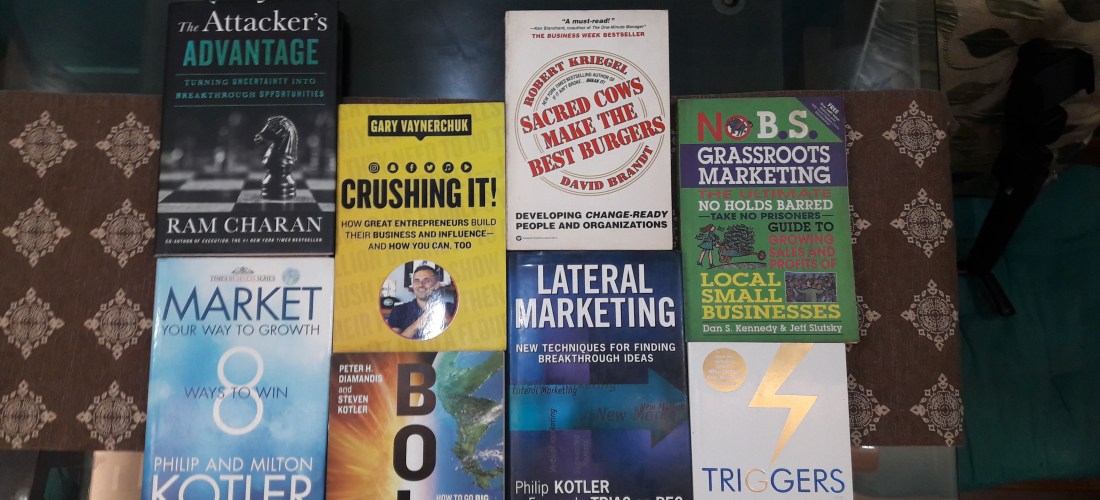
Books

books, Great People, mindset, Reference Guides, Youngsters

Books are a man’s best friend….so the saying goes.

For me books have always been a huge treasure where I have spent a huge fortune. Till I bought my tablet, physical books were what I bought and there are more than a 1000 books in my house and I have also given away another 200 odd books.

Since I bought my tablet I have moved towards buying books on kindle for 3 reasons, the space for keeping physical books has fallen in my house, I prefer to not use paper because it reduces our forest cover and last but not the least, it appears on my Kindle immediately. When I ordered physical books, I had to wait for about a week or more before I got the books delivered to my home.

Some books leave a very strong impression on me and I write about those in my blogs as I read the books.

Last few days I have been reading Steven Kotler’s The Art of Impossible. This is an amazing book. Its very dense with.a lot of knowledge packed in it with lots of data to back it up. If you like to read non-fiction books, especially in the area of human performance then, Steven Kotler is among the few authors I would highly recommend. This is another book which is going into my categories of reference guides.

Now coming to the main point of this post.

Steven actually gives out a Return on Invested Time of reading various formats of written material. I am giving his logic below because I have not come across any author giving such a clear and concise argument for reading a book.

As per him for reading

  1. a blog post which generally takes 3 min – the author would have spent about 3 days to build the content.
  2. an article in a magazine, that would take about 20 minutes to read, the author would have spent about 15 days of research
  3. a book which takes about 5 hours to read would have knowledge of maybe 15 ears of research.

While most blogs are free to read, include this one, you have to spend a little amount of money to buy a magazine, but you have to spend a decent amount to buy a book. The argument which Steven is placing is that for the 5 hours that you invest and the cost of buying, you are getting a bargain for the 15 years that the author invested in getting the knowledge in place.

I have never bothered about the cost of buying books as an issue because since my childhood, my parents inculcated the habit of not compromising on buying knowledge.

But this argument changed my way of looking at reading a book. With the 15 years of knowledge that the author puts in, you are accelerating your learning process so dramatically. That’s why most of the great people have reading lists and recommendations. However the learning would only if you have a growth mindset. Chances are that if you have a fixed mindset, you will not even pick up a book to read.

For the younger generation this could be an eye-opener. The only other way I can think of shortening your learning curve would be attending a live training where you can interact with the coach and other participants.

Let me know in the comments below if you also think alike.

Till next time then.

Carpe Diem!!!

Gratitude

Gratitude, mindset, possibility thinking, Uncategorized

I have written a lot about Karma and gratitude even if you don’t believe in God. I have generally used these things with the view that the Universe conspires to do good to people who do good for others.

In the last few days you would have noticed I have written a lot about the book by Steven Kotler , The Art of Impossible, that I am reading.

In this book I came across actual research data by Barbara Fredrickson, that spoke about positivity ratios and that it takes about 3 positive thoughts to nullify the effects of a negative thought.

What better way to get positive thoughts in your mind than being gracious about what you have achieved, being thankful for that.

There will always be things about which you can feel bad. Someone overtakes you on the road from the wrong side or the ticket clerk at the metro station didn’t behave properly. Our mind has the ability to spiral out of control with negative thoughts. More than the thought itself, its the emotion with which we think about the thought that causes the bigger problem.

When you are thanking God, the Universe or whoever for what you have, and where you have reached from where you started the emotions just can’t be negative. When the mind starts having gratitude multiple times a day, slowly the mind gets more restful I have noticed. Maybe its the positivity ratios which kick in. Once the mind is more restful, you start having better ideas for solving problems. Possibility thinking helps find more options to solve the same problem.

When you solve problems, there’s a dopamine kick which comes in which makes you feel even better and the positive spiral starts.

I first got introduced to this idea by Tony Robbins but didn’t actually follow it religiously. But I saw some videos by Dan Sullivan, in which he spoke about how people with a gratitude mindset are able tot create more abundance. That got me hooked on to this idea and since then I have been following it very religiously.

Till next time then, be grateful for what you have today.

Carpe Diem!!!

Our human brain

Breathing, Health, Human Brain, messaging

As I have written in my post a couple of days back, these days I am reading the book The Art of Impossible: A Peak Performance Primer by Steven Cutler. Steven does a lot of research for the books he writes. Some of his earlier books which I have liked a lot, jointly written with Dr. Peter Diamandis, include Abundance, Bold.

While the television and newspapers throw so much negative news all around us, if you read these books, you realise that the world is a much better place to live in today than what it was say 300 years back. And a major reason for that according to the authors is the fact that technology is playing such a major role in making this place a better place to live in.

As I mentioned earlier, Steven does a lot of research for his books. If you have been reading my blogs, you will also notice that I am always trying to find ways to improve the performance of my brain and my body. Whether its reading faster or breathing techniques which help build stamina, I am always looking for queer facts about this complex machine called the human body.

One thing which caught my eye today was the fact that our brain can only process about 126 bits of incoming information per second. The key word is incoming i.e from various senses to the brain, which interrupt the processing function of the brain. These bits need not be equivalent to binary bits (0,1) that technology folks look at since the brain works in a more abstract fashion.

This does not include the processing capability which the brain has, which is enormous. And that’s why people talk about being focused so that you are interrupting your brain with less inputs and doing more processing.

I don’t know about you, I have always considered myself to be easily distracted and I am not able to comprehend things, if they come too fast at me. For example trying to find my gate number for the flight from 5 screens of arrival and departure information.

Or if someone gives me too many food options from which to choose very fast.

I have to deliberately slow down the intake of information. In meetings to avoid such situations when too many people are speaking, I have to ask people to just be quiet and answer only the questions which I ask.

Today I realised this is not a problem only with me. Its a problem for al human beings. If our brain can only process so much information at a time, then for us to be able to influence someone we need to be able to give information in such a way that is simple to process and can get analysed. That’s where I guess charts look are understood compared to reports.

For a practitioner of marketing it means that are messages should be small simple sentences with more pictures, images.

Can you think of what other implications can this have for us in marketing. Pls write in your comments below.

Till next time then

Carpe Diem!!!