WHO NOT HOW – more than 7000 years ago

collaboration, Habits, Leverage

Dr. Benjamin Hardy — one of the most prolific writers on Medium has co-authored a book WHO NOT HOW. He has co-authored this book with one of my favorite thinkers Dan Sullivan.

The basic premise of this book is that if you leverage your relationships, you can solve all kinds of problems more easily as well as much much more quickly.

I finished reading this book yesterday and saw the immediate applicability all across my life. 

But what surprised me when I was going through the book was the fact that two of Indian Mythologies’ the Ramayan and the Mahabharat are completely about WHO NOT HOW. Both are huge texts and its not my agenda to go into a religious discourse but if you see the key architects of these texts you will immediately see the applicability of this rule.

In Ramayan — Lord Ram’s wife Sita is kidnapped by the demon king Ravana. Lord Ram and his brother Laxman are travelling in the forest helter-skelter trying to figure out where Sita could be when they come across the Monkey King Sugreev and his able chieftain the Monkey God Hanuman. 

In true “give” before you “ask” form that Dr. Ben Hardy suggests —Lord  Ram first helps Sugreev get his kingdom back from Bali and then the complete army of monkeys ably led by the Monkey God Hanuman help identify where Sita is and then with their help Ram and Laxman fight with the demon king and kill Ravana and his generals.

If it was not for the Monkey God Hanuman they would have not been able to identify the location where Sita was held captive by Ravana. They used the Monkey God’s key capabilities to fly long distances and get an aerial view to isolate the location in Lanka. After that if it was not for the monkey army — who created the rock filled walkway in the sea — Lord Ram & Laxman would have not been able to cross the Indian Ocean to get into Lanka and fight Ravana

Lord Ram did not instruct them how to do their jobs —The Monkey God  Hanuman and his army of monkey were good in their jobs and were wanting to get Lord Ram to succeed…. exactly as Ben Hardy talks about the “WHOs” that you need to choose and not micro manage.

If Lord Ram and his brother had tried to do everything on their own they would have taken a much longer time to first figure out the location and then go about trying to get there. 

I am sure if you try to think about it, most of the major achievements in the world would not have happened without a WHO being involved. And this is not ONLY a vendor — customer relationship, that we are talking about. Its about also relationships where there are no payments getting made.

Till next time.

Evolution – the gradual development

Evolution, Financial Independence

Yesterday I was listening to the I Love Marketing podcast episode#387 (ilovemarketing.com) . If you are in any way connected to marketing, this is by far one of the best podcasts. Joe Polish and Dean Jackson give a ton of information absolutely free. Incidentally Dean Jackson also runs another podcast called More Cheese Less Whiskers and Joe has another one with Dan Sullivan called the 10X talk. All three highly recommended.

During the Q&A in this podcast while giving an answer, Joe spoke about how people first master a big pain and then when they are able to master one, they evolve and master another one and so on. So what starts as a specific issue to be mastered by an individual then becomes sharable with an audience. Then as the person becomes successful with one set of pain points he starts working on the other areas and improves there and then shares that. As per them most of the genuine personal development people actually have evolved this way.

Come to think of it, if you have been reading my blog, it has all been about the challenges I faced initially with my finances. As the years passed and I became more and more enthralled with the idea of compounding, I started sharing my life lessons on this blog. I have been a big proponent of starting small and letting the magic of compounding play its role. How even being able to carve out small amounts could help you get out of the financial mess towards financial freedom. I have shared the 100s of books I have read on the subject and even given out key ideas for everyone to work with

As I evolved from that level I started focusing on my abilities to read more and retain more, improve my health and other things.

Coincidentally I wrote in my blog a couple of weeks back, before I had heard this podcast, that my blog is going to now be talking about multiple things instead of just financial freedom/independence.

So I think I am on the right track in my own evolution and in sharing my journey with you folks.

Let me know your views.

Till next time….

Changing the narrative

compounding, Financial Independence, Health, Marketing

Hello Everyone. Its been quite a few months since I wrote on my blog. I hope all of you, your families and near and dear ones are safe during these tough times.

I have been contemplating a lot about what should constitute my next items on the blog and the structure. While I have been writing over the last few years on “The Magic of Compounding” and its ability to create “Financial Freedom” I was wondering what would be the outcome for someone to achieve financial freedom. Is that outcome really worth the effort.

So that’s what’s been keeping my mind occupied. I have been reading a lot of books in the meantime, which I will analyse in the coming weeks. The biggest benefit which I could think for getting “Financial Freedom” is to have a life well lived. So compounding becomes a tool to get financial freedom and the freedom you get helps you live your life to a full potential or at least with less regrets of “What Could have Been”.

To be able to “Live Life Well” then you need to have other things also.

  1. You need to be in good health – if you don’t have health then all you will think of is your ailments – but if you have good health then you can dream about other things
  2. You need to be able to dream and change contexts from your present scenario – which means you need to gain more knowledge, visit new places and gain more varied experiences
  3. You need to excel on your own Unique Abilities ( a term Dan Sullivan of Strategic Coach uses very often)

Let me know your comments below on what else you think is needed to “live life well”

So I will be changing the narrative of my blog as we go forward – I will not only talk about “Compounding” and “Financial Freedom” which I am very passionate about, but also look at other areas like Marketing and Health.

Marketing and being able to present things and interact with people has been one of my areas which I think I am very good at. So I would like to share those ideas as I come across them.

In addition I have been very fascinated with how improving my daily health habits has helped me improve myself. A lot of you could be in a similar boat so I would love to share those aspects as well.

When I started blogging my emphasis was to help people especially youngsters to avoid the mistakes that I had made as I reached middle age in my financial abilities.

Now while I will keep on that, the narrative would change to also include how a better health and better marketing could help write on our tombstone – This Person Lived Her/His Life Well

So till next time ….

Carpe Diem!!!

Law of compounding – for real life improvement

Affirmative action, compounding, Human Brain

I read – maybe 10 years back – Delivering Happiness by the CEO of Zappos – Tony Hsieh. I don’t quite remember everything in the book except that it was the journey of Zappos. However there is one statement from the book which Hsieh makes, which has remained with me since then, if you can improve even 1% everyday, imagine the improvement you will have at the end of the year – 367%. However inspite of having read it and also put it on a board where I could see it everyday, I have not improved 3670% in the last 10 years. The idea is simple I understand it but I still don’t go about achieving it.

The Japanese have a incremental improvement method called Kaizen which is about bringing about small incremental improvements continuously resulting in massive improvements over a period of time.

Both seem to be very simple concepts but we don’t end up following them. If you have been following my blog for sometime you would have noticed that as I am getting more experienced at writing things I am also questioning things about how I can be improving myself. Right now I am working on improving my reading capabilities. I have an agenda to read at least 3 books every week, consistently over the next few months, inspite of all the extended working hours we are having due to the lockdown. I want to check if I can improve my reading, which means I gather more knowledge, which then I try to put into action and therefore improve myself on a regular basis.

Yesterday however I was watching a YouTube video of Dan Sullivan of Strategic coach and he explained a very simple concept because of which I may not be achieving our goals for real life improvement. His logic is that there are no impossible goals, there are only impossible timelines. And because we give impossible timelines to ourselves, we end up messing up on achieving our goals. In case you are interested you can watch the video here.

As per him if we were to give ourselves long enough timelines, then our brain will not put barriers. The timelines he talks about doing a 10X is 25 years and breaks it down into quarters. So in 25 years there will be 100 quarters. If we were to use our compounding equation S=P*(1+r/100)^n. So if we put P=X and S=10X and “n” =100 then “r” turns out to be just 2.5% growth per quarter.

Is it feasible to improve 2.5% per quarter or less than 1% per month. Should be possible. If we were to break down our improvement points into clear bite sized goals then 1% per month should be very feasible and 10X in 10 years should also be feasible.

The reason this compounding works is because as a human being when you improve the first time, the next improvement is over the previous improvement and this cycle can continue forever. This is exactly how compounding works on your money and this how compounding works in real life as well. However our brain is conditioned to think in terms of linear activities. It is just not capable of comprehending non-linear equations like compounding and therefore whether it comes to money or self improvement our brain plays games with us.

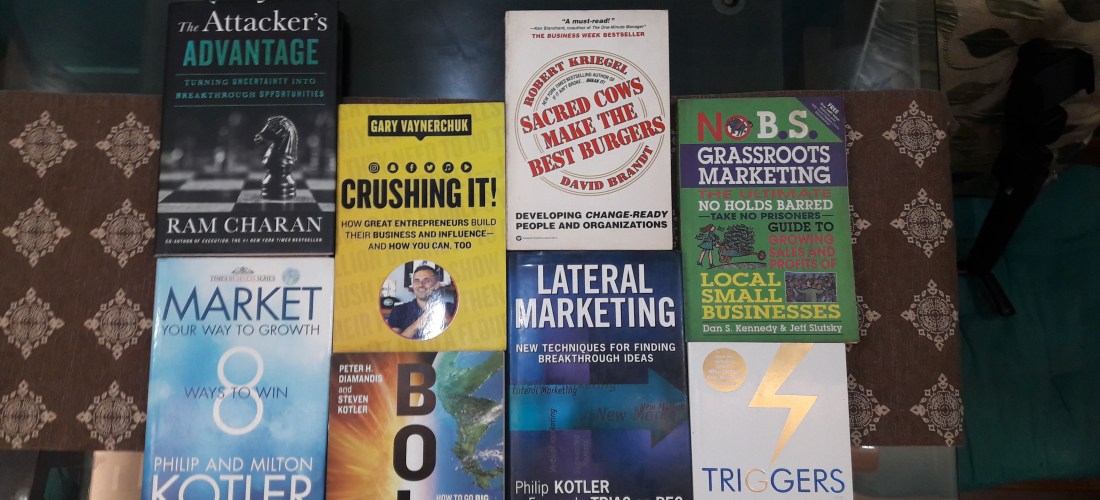
Its one of those laws which are universal in nature and should apply to me as well. If I can improve by more than 1% every month in different areas of my life, based on the knowledge I acquire by reading the books and taking action, I should be able to grow. Let me see how this goes. Just to share the progress in the last 3weeks I have been able to complete 8 books. All non fiction books. These include Crushing It by Gary Vaynerchuk, Bold by Peter Diamandis, Attackers Advantage by Ram Charan, Triggers By Marshall Goldsmith etc. All these books are quite dense, as you will see in the picture, but I am trying to keep to my target.

Let me know if you also see Compounding in other areas of your life. I will be very interested in hearing your story.

Till next time.

Carpe Diem!!!