Compounding & the relevance of period

Financial Independence, Uncategorized

Last time I had written about why human beings are attracted always towards the complex items and don’t understand simple concepts like compounding.

One thing which comes to my mind is the fact that compounding works on 2 key parameters….longer periods of activity(of years in case of money)  and higher rates (of interest in case money).  While the human brain is very good at figuring out things quickly by identifying patterns, it gets completely foxed when complex calculations need to be done.

For the first 4-5 periods of activity, there is no appreciable change if you when you start with small values, because of which it seems that nothing worthwhile is happening.  So if you have started with 1 Rupee after 5 years if you only have got 2 rupees you are not able to comprehend how big the number can become. Its only later that the fun starts taking place.

Look at the table below.  The IPL cricket season is about to start in India and people in India could relate to this idea. It could be wickets in a game of cricket or holes in a game of golf.  We will start with a dollar for every wicket / hole taken in a match and double it for the next one till we take 18 holes in golf or wickets:

Wicket in cricket / hole in golf Amount doubled after every wicket/hole
1 1
2 2
3 4
4 8
5 16
6 32
7 64
8 128
9 256
10 512
11 1024
12 2048
13 4096
14 8192
15 16384
16 32768
17 65536
18 131072

Would you wager a bet with anyone on doubling the amount on each outcome.  You wouldn’t if you see how what starts with just a dollar becomes more than One hundred Thirty thousand dollars.  As a matter of fact Tony Robbins has a post specifically on this idea.

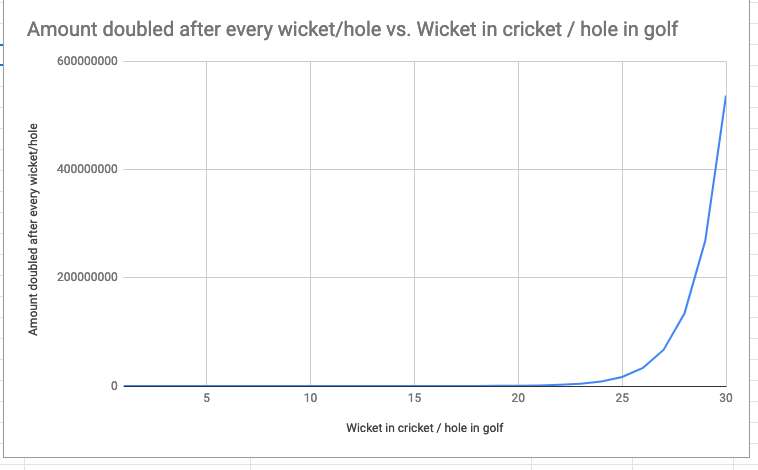
If you were to take this forward to a 22nd wicket/hole can you comprehend the value – it will be …it will be 2 million (20lakhs)….and by the 30th hole it would have become…Half a billion dollars (or 500 crores).

Warren Buffets actual growth of wealth has been after the age of 60 because of this phenomenon.  Its the age of the investments that have enabled the compounding to start playing a role.

Think about it.  If you were to ensure that you were to keep money for your child from the time she is born, you will make her a real rich person by the time she is 45-50 without her doing anything….at all.

For those of you who are more visually inclined pls have a look at the chart below
Screenshot 2019-03-17 at 10.22.33 PM

Next time we will take the same example by comprehending different interest rates and show how the different rates can change the graph.

Till next time.

Carpe Diem!!!

How do you take the message of compounding to the “bottom of the pyramid”

Financial Independence, Uncategorized

The concept of the “bottom of the pyramid” was brought forward by the late management guru C.K.Prahlad.  His basic premise was that people with lower incomes also have aspirations which are similar to the middle class.  If the consumer companies can produce products in lower volume packaging and lower margins, then the absolute amount of profit that companies can make will be dramatic.

The typical case was how the volume of shampoo usage went up dramatically when companies started creating sachets which were priced at Rs1/- per sachet (about 10ml).  All brands eventually followed this model eventually and everyone’s business in FMCG space grew dramatically in the 90s and thereon.

During most of their interviews, stock market stalwarts like Ramesh Damani or Raamdeo Aggarwal or Mohnish Pabrai talk that becoming rich is not very difficult.  You just need to make sure that you are compounding at an average of about 24% per year and in 30-40 years what ever value you start you would be about 10000 times in 40 years.  Most of these stalwarts and people like Waarren Buffet have been compounding on an average more than 35% for a long period of time.  At 24% also, if you were to start with $100 today you would have $1million in 40 years.  These stalwarts don’t tire telling everyone willing to given them an ear that compounding is the only magic that anyone needs to understand.

I have tried many a times to tell my maid, the Uber drivers whom I sometimes interact with and a lot of people from the lower income group whom I come across about the power of compounding.  Everyone listens but then no one takes action to start investing.  They are unhappy about their situation but they are not willing to take action.  They are willing to work harder to earn a little more but they are not willing to start investing and let money work for them.

Which brings me to the question – are we happier being in a rut which we know off but not willing to take action to get into another situation which may actually make us better.  Is this true only of people at the lower income levels or is it seen at other levels also.  To be fair there are a lot of aspects of life, where I also tend to be stuck in inertia and don’t take action to move forward because I prefer the known compared to the unknown.

I think we take the simplicity of compounding lightly.  Like all universal principles, relativity, 80/20, compounding is also so simple in its depiction but very difficult for most people to comprehend in its applications. Even well educated colleagues of mine think that compounding results which I show them are good to look at when seen on an Excel sheet but in reality its not possible.  If we keep investing aside, the whole Japanese concept of Kaizen is based of very small incremental improvements having a dramatic result because the benefits compound when done continuously over a period of time.

To return to the topic, how do you take the message of compounding to the masses for every aspect of our life, not only in aspects of finance but for every sphere of life.

Have any of you had success with taking the message of compounding to the masses.  Would you be willing to share it with everyone.

Look forward to hearing from all of you.

Carpe Diem!!!

Are you covered to live past 90 years

Financial Independence, Uncategorized

I had gone to Lucknow ( capital of the state of UP in India) last week for celebrating the Golden Anniversary of one of my in-laws.  In their house they have a decent size lawn and also a lot of pots and trees in the garden.

While sitting in the garden, having my coffee I noticed an old man mowing the lawn with a manual lawn mower.  Since you don’t get to see a manual lawn mower too often these days I got talking with my in-laws about it.

That’s when my in-laws mentioned that the gardener was in his 90s and peddled down on a bicycle about 17 km everyday to come to their house and do the gardening. He does gardening in about 5 lawns in the vicinity and spends an hour at each location. He earns about 5000-7000 INR every month- about USD 900 /annum.

The positives from the interaction were that he was so healthy and fit even at 90.  He was able to move large pots around even though I would never be able to lift those plots.  I felt extremely happy to see a 90 year old, so healthy and independent.   I did not get an opportunity to talk to him because I got caught up in some other engagements there.

However it got me thinking, would he want to do this activity if he had the financial freedom. Was he working because he had to earn his daily bread or what were his circumstances at home which pushed him to travel 365 days on a bicycle to earn such a meagre amount.

When I visited Canada in 2017 in one of the department store I saw ladies at the cash counters who in my opinion were more than 70 years working on the basic minimum wage only because they did not have any savings to last them their remaining life. Yesterday I met one of my old colleagues who is now settled in the USA and he mentioned that the official retirement age in the US is now 67.5 years.  So as countries are ageing they are trying to increase the official working age.  But for countries like India where the population is still very young, the increase in retirement age from 58-60 in most cases is still afar cry.

Globally the average age of the people is increasing with better nutrition and medical support. If Dr. Peter Diamandis is to be believed in the next decade the breakthroughs in science will help people live well over a hundred years.  However the working life of an individual is only about 30-40 years while they will have to support themselves without an active income for the next 30 odd years.

Just with pure saving instruments its not feasible to beat inflation and grow your money.  You need to be investing money on a regular basis from a very young age so that the you can get the benefits of compounding.  If you will notice Warren Buffet’s dramatic growth in wealth has been after he crossed the age of 60 because the compounding equation is an exponential equation and as the number of years goes up the impact on your investment is dramatic.  He started investing in his early teens, so close to 70 years of compounding has made one of the richest men on the planet.  At around the same age our gardener is still trying to earn USD 900/- per annum because he did not make investments.

Compounding is such a simple equation that grade 7 students are taught in school mathematics.  However our teachers are not able to show the implications of that equation because what is simple is not always easy to comprehend and most people inspite of knowing it don’t apply it ever.

I would strongly recommend everyone to read the book “The Compoound Effect” by Darren Hardy to see the benefits of compounding in all walks of life.

Use this simple equation to make your life easy for the long run and be secure to live well beyond 90 years.

Carpe Diem!!!


Sponsored meals for one year for 12 kids.

Financial Independence, Uncategorized

In my blog of 10th December 2018, I had mentioned that using Paul Dunn’s concept of Buy1Give1(B1G1.com) in a slightly different way- because I don’t have a business of my own – I intend to give away a dollar for ever new follower of my blog/website and Linkedin –  and achieve my objective of donating to my charities on a regular basis.

Based on the number of followers I have today on my website/blog and the new followers on Linkedin, I have added a dollar for each. I have been able to donate meals for one year for 12 kids on Akshay Patra.  I have a target to reach the capability to sponsor one meal for one year for 100 kids.  If the number of followers on my blog/website and Linkedin keep growing I should be able to hit this number also pretty fast. Right now I am active only on these two.  Slowly I will raise my activity levels on other media as I see success.  If you are interested in knowing more about the work the click Akshay Patra.

If you compare Tony Robbins’ agenda he wants to be able to feed 6-8 million people in a year.  He has written 2 books Money Master the Game and Unshakable and donated all the proceeds to help achieve that objective.

My  achievement seems so small compared to what Tony is doing.  But as I mentioned, I got inspired by Paul Dunn’s Ted Talks that even very small regular interventions can dramatically improve the world.  If you have not heard Paul’s 4 Ted talks, I sincerely suggest you watch them. So what I used to do haphazardly and irregularly earlier, now becomes a system.

In multiple posts earlier, I have mentioned that I follow Mohnish Pabrai, the US based fund manager who runs Pabrai investments.  He runs the Dakshana foundation to which he is every year donating a certain portion of his wealth.  Mohnish is an ardent follower of Warren Buffet and like Warren, wants to donate a certain portion of his wealth every year. This foundation helps poor, deserving  kids in India, who have potential, to get trained so that they can appear for entrance exams and qualify for the best engineering (IITs) and medical institutes(AIIMS) in India.

Now Mohnish has a major lament, which I have noticed in his YouTube videos. He believes that given the speed at which he is donating his wealth year-on-year to Dakshana, there will not be enough deserving kids left who have potential to be trained.  His feeling is that there are not enough deserving kids coming out of the government/municipal education institutes in India.

One of the reason for that, is that poor parents don’t send their kids to school even though school education in India is now virtually free in all states. They want the kids to work and earn some money, so that the family can be fed.  The more hands working the more possibility of earning. If we eliminate the challenge of feeding the kids, that too with a very nutritious meal, then these parents will also send their kids to the government schools. Akshay Patra kind of organisations are helping achieve that goal. Once the kids are fed well, they will be more healthy, have less sickness and  they will hopefully also learn well and then the Dakshana Foundation  kind of organisations will get more kids to train for higher eduction.  Once more kids get educated they will bring up the “standard of living’ of their families.  From the ground-up we will be able to take India and the world forward

Again the 12 that I have sponsored or the 100 that I have a target for, may not create a positive Tsunami but if more people like me keep doing these small interventions we will make this world a better place.

Till next time then….

Carpe Diem!!