Marketing – how individual biases play havoc

ego, Marketing, mindset

Individual biases influence on both sides of a transaction – the buying side and the selling side.

Today I will look primarily at the selling side of a transaction and how our individual biases tend to make a mess in a marketing activity.

A simple example could be the way our website should be organised. Depending on the kind of dispensation in the marketing team you could have a staid looking website or a very aggressive looking website. There is nothing wrong in either of these extremes or even in something in-between. The point that needs to be kept in mind is about – who is the customer you are targeting.

If you are targeting a mature audience and you present a staid looking website which is very functional , it might work very well. On the other hand a startup might create a very good user interface for the younger generation but the older generation is not able to get their arms around it.

Since we think the world sees everything the way we see something, these challenges arise. The way we see things is a function of our exposure, our biases, our mindset and our capabilities.

I have a personal bias against doing news paper advertisements. Its just my belief that our kind of business does not have a mass appeal and therefore a newspaper is not the best place to spend money. As a matter of fact you would have noticed this bias in some of the posts that I have put out earlier. Having said that this bias could also be limiting our growth because we have never tried to see its proof.

Another place I see this happening very frequently is summarily dismissing a segment of the market that may not buy. Again I will give my examples so that you know none of this is theoretical. Today itself I had one interaction where I was told that the hospitals are investing a lot of money in IT especially after Covid. I have had this personal bias that hospitals invest in medical equipment, in faciliies but only invest the basic minimum in IT and therefore we have not invested in that area.

Biases happen because of our experiences, so there’s nothing wrong, as long as we are willing to question them from time to time, it should not become an ego issue, otherwise we can lose on lots of opportunities.

Till next time then.

Carpe Diem!!!
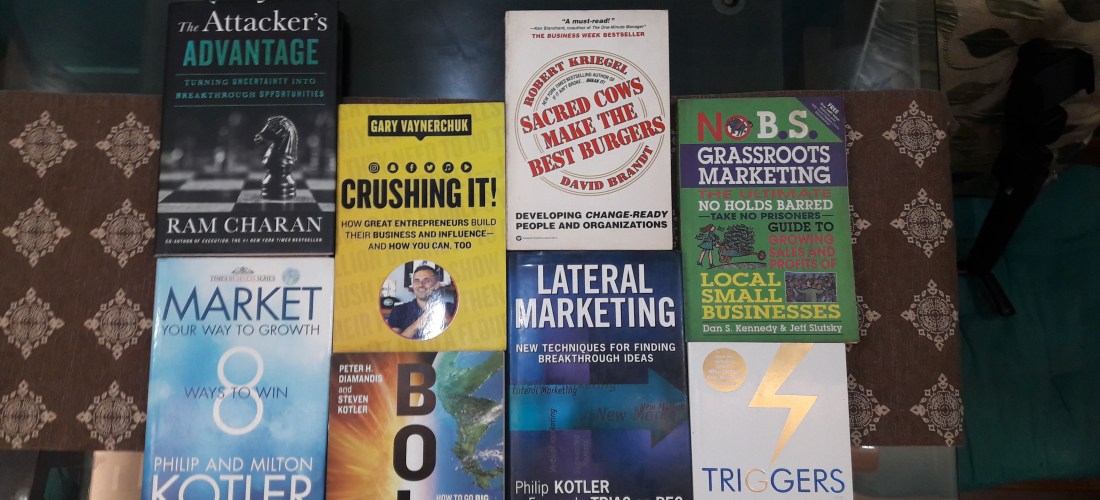
Books

books, Great People, mindset, Reference Guides, Youngsters

Books are a man’s best friend….so the saying goes.

For me books have always been a huge treasure where I have spent a huge fortune. Till I bought my tablet, physical books were what I bought and there are more than a 1000 books in my house and I have also given away another 200 odd books.

Since I bought my tablet I have moved towards buying books on kindle for 3 reasons, the space for keeping physical books has fallen in my house, I prefer to not use paper because it reduces our forest cover and last but not the least, it appears on my Kindle immediately. When I ordered physical books, I had to wait for about a week or more before I got the books delivered to my home.

Some books leave a very strong impression on me and I write about those in my blogs as I read the books.

Last few days I have been reading Steven Kotler’s The Art of Impossible. This is an amazing book. Its very dense with.a lot of knowledge packed in it with lots of data to back it up. If you like to read non-fiction books, especially in the area of human performance then, Steven Kotler is among the few authors I would highly recommend. This is another book which is going into my categories of reference guides.

Now coming to the main point of this post.

Steven actually gives out a Return on Invested Time of reading various formats of written material. I am giving his logic below because I have not come across any author giving such a clear and concise argument for reading a book.

As per him for reading

  1. a blog post which generally takes 3 min – the author would have spent about 3 days to build the content.
  2. an article in a magazine, that would take about 20 minutes to read, the author would have spent about 15 days of research
  3. a book which takes about 5 hours to read would have knowledge of maybe 15 ears of research.

While most blogs are free to read, include this one, you have to spend a little amount of money to buy a magazine, but you have to spend a decent amount to buy a book. The argument which Steven is placing is that for the 5 hours that you invest and the cost of buying, you are getting a bargain for the 15 years that the author invested in getting the knowledge in place.

I have never bothered about the cost of buying books as an issue because since my childhood, my parents inculcated the habit of not compromising on buying knowledge.

But this argument changed my way of looking at reading a book. With the 15 years of knowledge that the author puts in, you are accelerating your learning process so dramatically. That’s why most of the great people have reading lists and recommendations. However the learning would only if you have a growth mindset. Chances are that if you have a fixed mindset, you will not even pick up a book to read.

For the younger generation this could be an eye-opener. The only other way I can think of shortening your learning curve would be attending a live training where you can interact with the coach and other participants.

Let me know in the comments below if you also think alike.

Till next time then.

Carpe Diem!!!

Gratitude

Gratitude, mindset, possibility thinking, Uncategorized

I have written a lot about Karma and gratitude even if you don’t believe in God. I have generally used these things with the view that the Universe conspires to do good to people who do good for others.

In the last few days you would have noticed I have written a lot about the book by Steven Kotler , The Art of Impossible, that I am reading.

In this book I came across actual research data by Barbara Fredrickson, that spoke about positivity ratios and that it takes about 3 positive thoughts to nullify the effects of a negative thought.

What better way to get positive thoughts in your mind than being gracious about what you have achieved, being thankful for that.

There will always be things about which you can feel bad. Someone overtakes you on the road from the wrong side or the ticket clerk at the metro station didn’t behave properly. Our mind has the ability to spiral out of control with negative thoughts. More than the thought itself, its the emotion with which we think about the thought that causes the bigger problem.

When you are thanking God, the Universe or whoever for what you have, and where you have reached from where you started the emotions just can’t be negative. When the mind starts having gratitude multiple times a day, slowly the mind gets more restful I have noticed. Maybe its the positivity ratios which kick in. Once the mind is more restful, you start having better ideas for solving problems. Possibility thinking helps find more options to solve the same problem.

When you solve problems, there’s a dopamine kick which comes in which makes you feel even better and the positive spiral starts.

I first got introduced to this idea by Tony Robbins but didn’t actually follow it religiously. But I saw some videos by Dan Sullivan, in which he spoke about how people with a gratitude mindset are able tot create more abundance. That got me hooked on to this idea and since then I have been following it very religiously.

Till next time then, be grateful for what you have today.

Carpe Diem!!!

Gap and Gain – Part 2

Habits, Happiness, mindset, self esteem

Continuing on this concept that I started of on yesterday, Dan Sullivan has a very nice method which I have gathered from his books and videos.

He talks of looking back 25 years. Assuming you are more than 40 years of age. Then checking out where you were 25 years back and where you are today. Chances are that you have come a long way in terms of your earnings, your experience.

Based on that he says that in the short term there could have been challenging times ever so often, but in the long term you would have generally made it with a lot of achievements to be proud of.

Once you remember those moments, then it becomes easier to come out of a “down” state and look at the future with hope.

I have shared multiple tactics over the years when I feel. One of them is to see how far I have come from 25 years back. It changes my complete mindset and makes me happy.

When I look at things that way, I do notice that I have actually achieved quite a bit for myself. Comparing the 25 year younger me with the present me actually makes me eel quite happy.

Try this for yourself whenever you’re in the self pity mode.

Till next time then.

Carpe Diem!!!